


Powell Max Limited (NASDAQ: PMAX) is no longer just a "single asset" company; it’s pivoting into a diversified NASDAQ holding company. With a roll-up strategy targeting high-potential companies that have been starved for capital in a tough small-cap market, PMAX is positioning itself as the strategic partner these companies desperately need to scale. The goal is simple: build a lean, diversified powerhouse where 2+2 equals 6 by letting expert management teams run their businesses while PMAX handles the capital markets and corporate growth.
The blockbuster acquisition of Boston Solar and its $24 million in revenue is the first major building block, but it’s definitely not the last. PMAX is betting on a decades-long energy boom, starting with solar because the "sun is on right now," but the vision is to create a massive holding company that is unrecognizable in 24 months. By layering in AI to automate the corporate "minutia" and focusing on fundamental businesses that actually print cash, leadership is targeting a “several hundred million dollar” run rate and positive EBITDA within three years.
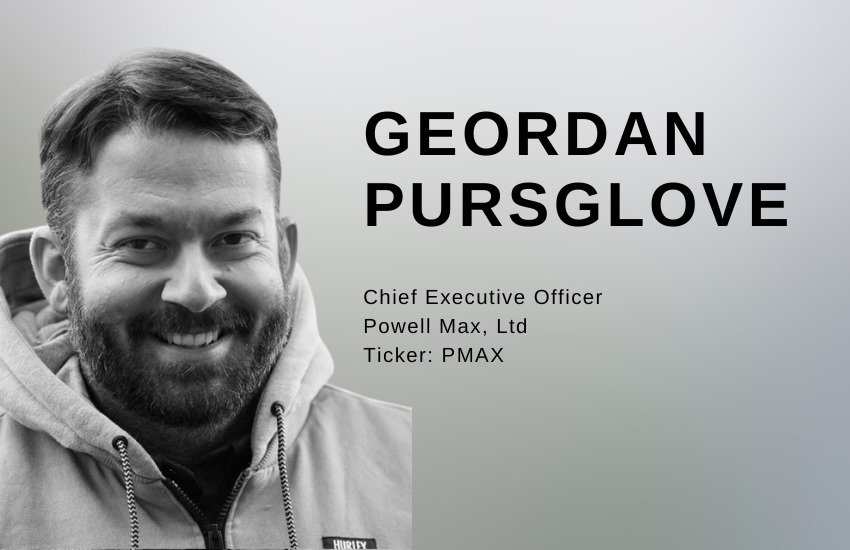
To better understand their vision, we sat down with PMAX CEO, Geordan Pursglove, to discuss the company’s disruptive strategy and its roadmap for long-term shareholder value.
Geordan Pursglove – CEO and Chairman
Geordan Pursglove serves as Chief Executive Officer of Powell Max Limited, where he is leading the Company’s transformation into a diversified, growth-oriented holding platform. Under his leadership, PMAX has advanced a strategy focused on disciplined acquisitions, capital markets execution, and building a scalable portfolio of fundamentally strong businesses. He brings deep experience in structuring and executing M&A transactions, raising capital, and positioning public companies for long-term value creation.
Mr. Pursglove also serves as Chairman and Chief Executive Officer of Lixte Biotechnology Holdings, Inc.(NASDAQ: LIXT), where he has overseen capital formation efforts, maintained Nasdaq compliance, and led key strategic initiatives, including a targeted expansion into adjacent technologies.
In addition, he serves on the boards of GridAI (NASDAQ: GRDX) and CyberScope Web3 Security Inc., and is Managing Director of The 2GP Group LLC, an industry-agnostic investment and advisory firm. Earlier in his career, he played a significant role at SemiCab Holdings, a subsidiary of Algorhythm Holdings, Inc contributing to its strategic merger, capital raises, and international expansion.
Mr. Pursglove brings extensive expertise across capital markets, mergers and acquisitions, and corporate governance, with a track record of scaling public companies and driving execution at the intersection of finance and innovation.
Full Interview:
Thank you for taking the time to discuss Powell Max Limited. For our investors reading, can you dive into PMAX’s latest move?
We are repositioning PMAX from a single-asset company into a diversified holding company, with the goal of enhancing stability, scalability, and long-term value creation.
How do you differentiate this from other M&A players who often struggle with focus?
We take a disciplined, strategic approach to building our portfolio—focusing on identifying and aggregating high-quality companies in compelling sectors, each with strong fundamentals. Our key differentiator is that we retain and partner with existing management teams, allowing them to continue leading and scaling their core businesses. This approach enables me to remain focused on overarching organizational strategy and capital formation, rather than becoming overextended across multiple subsidiaries. The result is a structure that drives amplified value creation, where the whole is significantly greater than the sum of its parts.
For the past few years, small-cap and micro-cap companies have been capital-starved, to say the least. Is that why now is the right time to build this on the NASDAQ?
Absolutely. The current environment presents a highly compelling opportunity for a roll-up strategy, as the market is in clear need of consolidation. Many of these companies are capital-constrained, creating favorable conditions for acquiring high-quality assets at attractive valuations. This allows us to deliver strong value for shareholders by securing businesses with significant upside potential, where even modest infusions of working capital can drive meaningful growth. From an acquisition standpoint, the market dynamics are exceptionally well-aligned with our strategy.
You recently executed an LOI for Boston Solar, which has $24 million in revenue and a 13-year history. Why was this the right "building block" to start with?
It represents an excellent foundational asset given its scale and strong underlying fundamentals. We are in the midst of a multi-decade energy boom, where no single solution will dominate—each energy sector will each play a meaningful role in a trillion-dollar plus energy market.
What particularly attracted me to Boston Solar was its strong pedigree, experienced management team, and the immediate availability of its core resource. It enables us to support the transition to decentralized energy and power the future today—without the delays typically associated with lengthy approvals or large-scale infrastructure development.
You’ve mentioned a focus on expanding outside of Massachusetts using industrial space. What does that look like?
There is a significant amount of underutilized industrial and commercial real estate across the United States, presenting a compelling opportunity for scalable energy solutions. We believe a lease-based model that leverages rooftop space at major national retailers—with extensive U.S. footprint—could unlock meaningful value.
By deploying solar infrastructure across these locations, these properties have the potential to evolve into localized clean energy hubs within their communities. This could also support complementary initiatives, such as EV charging, which may increase foot traffic and enhance the in-store customer experience. We see strong potential in partnering with established brands to help drive renewed engagement with physical retail while advancing distributed energy adoption.
I could see this as an opportunity to help weather the CRE crunch by selling unused space that sits in the sun all day. They could capture this energy and sell it back to the grid at a premium.
Yes, more than 20 states currently permit net metering, enabling us to sell excess power back to the grid and share in the resulting revenue. This creates a recurring income stream similar in concept to other on-site revenue-generating amenities.
By offering lease structures in which on-site solar generation significantly offsets—or effectively eliminates—tenant energy costs, landlords can enhance the attractiveness of their properties, attract higher-quality tenants, and revitalize underperforming commercial real estate assets.
You mentioned expanding into the adjacent Northeast states. What is a realistic timeline for that expansion?
They are well-positioned to execute. From their perspective, key contracts are in place and several bolt-on acquisitions have already been identified. Historically, the primary constraint has been access to capital—something we are well-equipped to address, enabling them to move forward with their growth strategy.
Over the past several years, Boston Solar has developed a comprehensive expansion plan and is now prepared to implement it. While progress will naturally depend on standard legal processes and their associated timelines, we expect meaningful transformation beyond the core Boston market. Over the next 12 months, the company should evolve significantly, and within the next 24 months, we expect the organization to be significantly expanded and materially transformed in both scale and scope.
How does an AI and NLP platform fit into a diversified holding company focused on infrastructure?
We are actively evaluating how artificial intelligence can be deployed to streamline operations, enhance efficiency, and optimize our organizational structure. The objective is to scale revenue meaningfully while maintaining a lean, highly effective workforce by implementing automated processes wherever appropriate.
On the energy side, AI can support grid optimization by analyzing demand patterns and identifying the most advantageous times to distribute or sell power back to the grid. Internally, it can automate routine, time-intensive functions such as financial reporting and accounting, improving accuracy while reducing administrative burden.
As a result, the benefits of consolidation are significantly amplified. By leveraging AI to manage behind-the-scenes operational tasks, our teams are able to focus on strategic growth initiatives and value creation, rather than being constrained by day-to-day administrative complexities.
PMAX is moving very fast. How do you pace these acquisitions?
We can calibrate our pace deliberately, as the geopolitical environment is unlikely to stabilize in the near term and does not present a risk of forcing premature decisions. While our progress may appear rapid from the outside, it reflects a measured and disciplined approach for our team.
M&A is a core competency for both myself and the board, grounded in extensive experience. As a result, we are able to operate with a high degree of alignment and efficiency, without the need for prolonged deliberation on execution.
We are not moving quickly for its own sake—we are moving with precision and purpose, ensuring each step is the right one.
What does PMAX look like in three years if this roll-up strategy executes?
We believe the Company has the potential to grow annual revenue by 10–20x over the next three years and achieve positive EBITDA. However, these projections depend on market conditions and execution risks.
Several of the acquisition targets under consideration maintain their own pipelines of potentially accretive opportunities that they have been unable to pursue independently due to capital constraints. In these situations, we intend to act as a strategic capital partner, supporting disciplined growth.
Our objective is to build sustainable revenue run rate and positive cash flow over this period.
Where do you think is the most underappreciated value right now?
We are focused on acquiring businesses with strong underlying fundamentals that are currently available at attractive valuation multiples and can be financed through conventional lending structures. By integrating these companies within a public platform, we can provide greater financial stability through consistent cash flow, along with enhanced access to the capital markets.
In addition to executing on these acquisitions, our objective is to deploy free cash flow in a disciplined manner—either to support continued growth initiatives or to return value to shareholders.
Looking ahead, we believe PMAX has the potential to achieve a revenue run rate, with positive cash flow and EBITDA, that will make it look unrecognizable in the next three years. At that stage, we would expect to allocate capital toward further expansion.
Is there a final message you want to leave for investors watching this pivot?
Over the past several years, market performance has been driven in large part by speculative activity; however, we believe conditions are increasingly shifting back toward an emphasis on fundamentals. Our strategy is designed to position the Company ahead of this potential rotation.
We believe that, over time, PMAX may attract broader investor attention as it demonstrates consistent revenue growth, positive cash flow, and earnings per share. Our acquisition approach is disciplined and selective, focused on building a scalable platform grounded in strong fundamentals rather than pursuing growth for its own sake.
We view this as a long-term value creation strategy, and believe it may present meaningful upside potential for investors who share a patient, fundamentals-driven perspective, subject to market conditions and execution.